Showing posts with label Unit 1: Contextual Studies for Creative Media Production. Show all posts
Showing posts with label Unit 1: Contextual Studies for Creative Media Production. Show all posts
Monday, 26 November 2012
New Wave Film-Final Product
New Wave film from Lewis Mercer on Vimeo.
This is my "New Wave" film that I created from the footage we had gathered over the various different shooting sessions over the course of this unit, I tried to use various different New Wave techniques within this like quick cuts, innovative camera movements and lighting.

Wednesday, 21 November 2012
New Wave Footage -Bin Labelling
Before I could start work on my New Wave film the various footage I had gathered needed to be properly labelled and organised so that whilst editing it would be easier to find all of my footage and arrange it easily.


 |
| This is my footage from the first shoot we did, I labelled the folder its all in "New Wave footage 1" |

 |
| These next 2 screenshots are from the second shoot where I labelled all of my footage and also labelled the folder "New Wave footage 2" |

 |
| These next 2 shots are screens of the final folder full of footage which I labelled "New Wave footage 3"
These screenshots show all of my footage after it was labelled and organized in order for me to easily find it whilst I'm editing my new wave film.
|
Future Shoots: Planning
We decided that we needed to shoot more footage in the future and we needed a way to plan everything, we found that email between each other seemed like the best way of communicating outside of the workplace. We decided that we should plan ahead for any shots or footage we might need in the future so we used email to try and plan out what we should do e.g. looking at any events or function see could film that may help us.


 The third and final attachment is another event which seemed to be appropriate for our purposes as it would be taking place at night, so it wold give us the chance to film some brightly lit areas and the chance to practice some camera techniques as well, although we could only have the possibility of going to one of these events if we were able to plan accordingly and rent out equipment, as well as arranging transport and meeting places, along with a set list of the tasks we would want to accomplish whilst there.
 This email is a reminder to everyone about the trip to oxford concerning the equipment we would need to take with us in order to film what we needed, this was sent a day or two before our actual trip so we at least some time to prepare.

This is an email I received informing me about certain events that would be taking place in the near future that we could use as an opportunity to gain some more footage.

This is my reply to the first initial email about future film shoots during one of these events, in which we could use to our advantage since we could get some decent footage from any of them.

This is one of the email attachments from the email which clearly explains some of the attraction sat one of these particular events, it seemed like a good idea to try out one of these events if we could to hopefully get some appropriate footage.

This second attachment is an event which we discussed together before we decided to try and use these events to gain some more footage that we could make use of, since the event would be at night we could get some decent footage of perhaps fireworks or a least some brightly lit areas.


Tuesday, 20 November 2012
Shutter Speed:Footage
During the course of filming we realised that we could most likely get some good looking tracking shots for use in our New Wave films so we decided to film from a car window whilst it was moving around various locations, although this presented a problem as we would need to first alter the cameras shutter speed before filming otherwise the footage would be too out of focus due to motion blur, so the first thing that was needed was to alter the cameras settings.
This footage shows a tracking shot from a moving car with the shutter speed set at 1/100s which is too slow as while the car is moving everything becomes distorted and blurred, the aperture was set at f/22 while the ISO was set at 1200 so everything was in focus, and the shutter speed was set at a speed that would allow an appropriate amount of light into the camera, however this caused the camera to capture the car movement at a slower rate causing this motion blur to occur.
This footage however shows the movement from the car more clearly, this is due to the cameras shutter speed being changed to a quicker rate of about 1/500s which captured the movement more clearly, also the other settings had not been altered so the ISO was still at about 1200, and the aperture at f/22 so everything was captured in focus and enough light was able to be absorbed by the camera to provide a bright look o the footage.
This footage could also be seen as new wave since it is using innovative camera movements to establish a tracking shot, using a cheap inexpensive and moderately effective method that requires almost no budget and it does show the local area where most of our footage takes place.
This footage shows a tracking shot from a moving car with the shutter speed set at 1/100s which is too slow as while the car is moving everything becomes distorted and blurred, the aperture was set at f/22 while the ISO was set at 1200 so everything was in focus, and the shutter speed was set at a speed that would allow an appropriate amount of light into the camera, however this caused the camera to capture the car movement at a slower rate causing this motion blur to occur.
This footage however shows the movement from the car more clearly, this is due to the cameras shutter speed being changed to a quicker rate of about 1/500s which captured the movement more clearly, also the other settings had not been altered so the ISO was still at about 1200, and the aperture at f/22 so everything was captured in focus and enough light was able to be absorbed by the camera to provide a bright look o the footage.
This footage could also be seen as new wave since it is using innovative camera movements to establish a tracking shot, using a cheap inexpensive and moderately effective method that requires almost no budget and it does show the local area where most of our footage takes place.
Innovative Camera Movements
One aspect of New Wave films that made them separate from mainstream cinema during their time was with the use of innovative and creative camera angles and movements using anything they could to move the camera in different ways, such as in Godard's "Breathless" where the camera is placed on the top of an escalator to film the woman as she ascends. The use of innovative camera movements can alter the way in which an audience views a film.
Spinning Shot test 1 from Lewis Mercer on Vimeo.
For this shot we tried to use a local parks "merry go round" as a way of making the camera spin whilst a subject was in the foreground, giving the appearance that the background was moving while the subject remained motionless. We used a setting of Aperture of f/22 to make the subject in the foreground in sharp focus however the background became blurry and out of focus which would be due to the spinning of the camera, we also used an ISO of between 600-800 so that the footage would be brighter as on the day we filmed this it was very dark and overcast.
escalator footage from Lewis Mercer on Vimeo.
This footage was done to try and imitate the scene from Godards "Breathless" where a woman ascends on an escalator and the camera is placed in front of her during the ride upward as if the camera is moving with her as an innovative and cheap alternative to a tracking shot, also we tried to shoot the footage in black and white to further imitate the scene from Godards film. This footage was done to be New Wave as it was using a single camera being handheld in a public area, and also we have no budget to film with so innovative use of the camera is needed.
This is a few examples of how we have tried to use innovative camera movement within our process of filming.
Spinning Shot test 1 from Lewis Mercer on Vimeo.
For this shot we tried to use a local parks "merry go round" as a way of making the camera spin whilst a subject was in the foreground, giving the appearance that the background was moving while the subject remained motionless. We used a setting of Aperture of f/22 to make the subject in the foreground in sharp focus however the background became blurry and out of focus which would be due to the spinning of the camera, we also used an ISO of between 600-800 so that the footage would be brighter as on the day we filmed this it was very dark and overcast.
escalator footage from Lewis Mercer on Vimeo.
This footage was done to try and imitate the scene from Godards "Breathless" where a woman ascends on an escalator and the camera is placed in front of her during the ride upward as if the camera is moving with her as an innovative and cheap alternative to a tracking shot, also we tried to shoot the footage in black and white to further imitate the scene from Godards film. This footage was done to be New Wave as it was using a single camera being handheld in a public area, and also we have no budget to film with so innovative use of the camera is needed.
Oxford Location - Turf Tavern
One of the last locations we visited whilst in Oxford was a local bar which we had heard a rumour about which was famous for the people who had visited it in the past, so we decided to investigate it for one of our final locations. Finding the location actually proved rather difficult as it was supposedly hidden behind a building and the only access to it was through a narrow alleyway, so it took a while for us to actually discover it, but once we did it proved to be quite a useful location as it lead out into a very open area but with many twisting paths leading to the streets outside, and the tavern itself was located next to a part of a medieval wall that ran through Oxford. Whilst in the location we managed o get a few panning shots of the surrounding building and also some cutaway shots which would most likely prove useful during editing, so the location seemed to offer some decent footage.
Filming location-Turf Tavern footage from Lewis Mercer on Vimeo.
For this location we decided to keep the same settings from the last location, using an aperture of f/22 to get everything in focus while using an ISO of 800 to ensure that enough light entered the camera, while since it was outside and there was a lot of natural light we kept our white balance at 5000 as well as keeping the shutter speed at 500/1
As with the previous locations we were required to obtain permission to shoot on the premises, so we explained the situation to hem and they were cooperative and friendly and gave us permission to film both outside and inside the building, although we tried to be careful as there were a few customers that were dotted around the location and we attempted to try and avoid filming anyone without their permission.
OH&S: Occupational Health and Safety
As with the previous locations there were a few health and safety issues that needed to be addressed before we began filming in this location, as there would be other people around and we would need to be cautious about how we handled the equipment as the ground was uneven. some of the other issues include:
Filming location-Turf Tavern footage from Lewis Mercer on Vimeo.
For this location we decided to keep the same settings from the last location, using an aperture of f/22 to get everything in focus while using an ISO of 800 to ensure that enough light entered the camera, while since it was outside and there was a lot of natural light we kept our white balance at 5000 as well as keeping the shutter speed at 500/1
 |
| Release form signed by staff of the Turf Tavern |
As with the previous locations we were required to obtain permission to shoot on the premises, so we explained the situation to hem and they were cooperative and friendly and gave us permission to film both outside and inside the building, although we tried to be careful as there were a few customers that were dotted around the location and we attempted to try and avoid filming anyone without their permission.
OH&S: Occupational Health and Safety
As with the previous locations there were a few health and safety issues that needed to be addressed before we began filming in this location, as there would be other people around and we would need to be cautious about how we handled the equipment as the ground was uneven. some of the other issues include:
- Risk of falling due to uneven ground
- Risk of damaging equipment
- Risk of injuring oneself or others
- Possibility of equipment being stolen
- Risk of fire
- Be cautious while moving around the location due to uneven ground
- Ensure that all equipment is secured before filming
- Ensure that all equipment is kept safely out of the way and in a visible location
- Be careful around others to avoid injury to crew members or patrons
- Ensure that no customers are filmed without their permission
Oxford Location - Record Shop
Another location we decided to film in was a local independent record store, we thought that as well as filming in the location we could ask about the local area and any social problems affecting Oxford at the current time which would provide us with some insight into any issues concerning the local area. We managed to get some decent footage from the record store and as the organised shelves and angular objects like cd and record casings made for some good compositional potential in our footage, it was also appropriate as it had many aspects of youth culture which is often shown in New Wave films so that was an added advantage since most of the customers were either young adults or students.
This is a montage of some of the footage we gained from the record shop.
Record shop footage from Lewis Mercer on Vimeo.
For this location our camera settings were set at an ISO of 800 with an Aperture that changed from f/22 whilst filming around the shop to an aperture of f/2.4 whilst conducting the interview with one of the employees. The white balance needed to be changed to 5000 instead of 8000 like in the sweet shop since there was a lot of natural light in this location.
Again we were required to obtain the manager of the stores signature in order for us to be allowed to film anything on the premises, so we explained our task to the employees and they were very friendly and cooperative so the process of obtaining permission went rather smoothly. One of the employees was even willing to give an interview where we could ask them questions about the shop and if there were any issues they were concerned about in the local area such as the music scene in Oxford. They were very willing and we were able to obtain an interview with them which turned into a documentary styled piece of footage.
OH&S:Occupational Health and Safety
As with any location there were a few health and safety concerns we needed to deal with before we began any filming in this location, as it is someone else's property extra care must be taken when moving around and operating any equipment.
This is a montage of some of the footage we gained from the record shop.
Record shop footage from Lewis Mercer on Vimeo.
For this location our camera settings were set at an ISO of 800 with an Aperture that changed from f/22 whilst filming around the shop to an aperture of f/2.4 whilst conducting the interview with one of the employees. The white balance needed to be changed to 5000 instead of 8000 like in the sweet shop since there was a lot of natural light in this location.
 |
| Release form signed by staff of "Truck Store" Record shop |
Again we were required to obtain the manager of the stores signature in order for us to be allowed to film anything on the premises, so we explained our task to the employees and they were very friendly and cooperative so the process of obtaining permission went rather smoothly. One of the employees was even willing to give an interview where we could ask them questions about the shop and if there were any issues they were concerned about in the local area such as the music scene in Oxford. They were very willing and we were able to obtain an interview with them which turned into a documentary styled piece of footage.
OH&S:Occupational Health and Safety
As with any location there were a few health and safety concerns we needed to deal with before we began any filming in this location, as it is someone else's property extra care must be taken when moving around and operating any equipment.
- Ensure that all equipment is stored away safely while not in use to avoid creating an obstacle for any customers
- Ensure that whilst walking around the shop extra care is taken to avoid falling and injury/damaging any of the displays or products/ crating an obstacle for staff or customers
- Make sure not to film any customers or staff without their permission
- Don't use or carry equipment in an improper manner to avoid risk of damaging it.
- Don't damage any products or furniture in the shop
- Ensure that all equipment is kept safe and secure whilst using/carrying it to avoid theft and damage.
Oxford: Location - Simms Sweet Shop
Whilst we were in Oxford we decided it would be productive to film in a few of the local shops in order to gain some footage of a part of the busy street scene in oxford but also to gain some insight into the local area and anything that what kind of shops most people would frequent, one such shop we decided to visit was "Mr Simms Traditional Sweet Shop", this seemed like a good idea to film in as locals of all ages would visit it at some point and the range of colours that would be present would prove a useful experiment for the cameras settings and various ranges of saturation of colour, also the neatly organised shelves would provide us with some good composition for our shots.
This is a montage of some of the footage we gained whilst filming in this location.
Filming on Location-Sweet shop from Lewis Mercer on Vimeo.
For this footage we used a range of different camera settings, the Aperture was set at f/22 in order to get everything in focus including the background, The ISO was set at 800 while we used a shutter speed of 500/1, a;so we needed to turn the white balance up to at least 8000 due to the lighting within the store otherwise the footage would of had an orange tint to it.
Before filming in this location however it was necessary to obtain a signature from the manager of the store on a release form explaining our task to give us permission to film on the premises as a requirement for us to be allowed to film anything. So of course we were polite and explained the situation to the shop staff and they were kind enough to allow us to use their premises to film in, although they mentioned that they would feel uncomfortable if we filmed any customers so we tried not to accidentally capture anything unnecessary on film incase a customer was in the frame, which would require us to get a release form signed by them as well.
OH&S: Occupational Health and Safety
During the time that we were filming in this location there were a few health and safety concerns that needed to be addressed as we were filming on someone else's property so we needed to ensure that there were no safety concerns before we began filming.
This is a montage of some of the footage we gained whilst filming in this location.
Filming on Location-Sweet shop from Lewis Mercer on Vimeo.
For this footage we used a range of different camera settings, the Aperture was set at f/22 in order to get everything in focus including the background, The ISO was set at 800 while we used a shutter speed of 500/1, a;so we needed to turn the white balance up to at least 8000 due to the lighting within the store otherwise the footage would of had an orange tint to it.
 |
| The release form signed by staff of Simms Sweet Shop |
Before filming in this location however it was necessary to obtain a signature from the manager of the store on a release form explaining our task to give us permission to film on the premises as a requirement for us to be allowed to film anything. So of course we were polite and explained the situation to the shop staff and they were kind enough to allow us to use their premises to film in, although they mentioned that they would feel uncomfortable if we filmed any customers so we tried not to accidentally capture anything unnecessary on film incase a customer was in the frame, which would require us to get a release form signed by them as well.
OH&S: Occupational Health and Safety
During the time that we were filming in this location there were a few health and safety concerns that needed to be addressed as we were filming on someone else's property so we needed to ensure that there were no safety concerns before we began filming.
- Ensure all Equipment is safety placed in a location that is out of the way and doesn't become an obstacle to anyone in the shop
- Ensure that all Equipment is safely secured while in use to avoid damage to it and possible injury to oneself or others
- Take caution not to film any customers without their permission
- Do not get in the way of customers or staff to avoid injury
- Take caution when walking around the shop to avoid falling and injury to yourself or others.
Monday, 19 November 2012
Recording Session 2: Oxford Preparation
Before we visited Oxford first we had a recording session to discuss what we would do during our visit such as shot types,roles and what locations we would visit in order to better help plan the course of the trip to save us time and energy and to get as much work done efficiently.
Meeting 2 Oxford preparation from Lewis Mercer on Vimeo.
Meeting 2 Oxford preparation from Lewis Mercer on Vimeo.
Recording Session 1: Future Film Shoots
In order to plan for future shoots that we would participate in we needed a way to discuss everything that would be needed in a way that we could easily go back to in order to check progress, so we decided to have a recording session where we would discuss everything that needed to be done such as shot types, locations, editing, different uses of camera tech and obtaining certain footage.
Meeting-Future Shoots from Lewis Mercer on Vimeo.
Meeting-Future Shoots from Lewis Mercer on Vimeo.
Friday, 16 November 2012
Contextual Study: Evaluation
At the start of this contextual study into cinematic New Waves I wasn't aware of neither the term nor the movement itself, so the initial task was to research and learn about the context and meaning behind a cinematic new wave and define it. To begin with the focus was on the French New Wave in cinema during the 1950-1960's, however as I learned more about the New Wave movements I discovered similar occurrences in other countries during roughly the same time, one such occurrence was the Japanese New wave movement that was happening in concurrence with the French New Wave, so I decided upon researching that particular movement as I thought it provide an interesting challenge.
To begin with the research was rather slow, as information on the Japanese New Wave was hard to come across, this is probably due to the movement not being well known in the west and was overlooked in the west due to the French New Wave occurring at the same time. Although information was initially hard to come across I was eventually able to learn of a few websites that gave details on specific directors which would help focus my research. There was however a large variety of different Japanese directors that were considered part of the new wave movement in Japan so I decided to only focus on one director, after viewing some basic information on a variety of directors I decided to go with the director I thought would be most interesting, Nagisa Oshima. As it would turn out the director I decided to research happened to be one of the most influential figures of the Japanese New Wave and drew many comparisons to the French New Wave in his films, which provided me with a range of useful discussion points for my research. I was also able to obtain access to a few books which I thought would be useful for learning about the contextual issues of the Japanese New Wave and for that I needed to travel to Coventry University library to obtain the information as they would have access to a wide range of texts which would help me gather information for discussion points on the context behind the movement in my study. As for the films by Nagisa Oshima, many of them are unavailable outside of Japan so many of the films by this director I was unable to access. The films I was able to obtain however caused a problem as I needed to order them from a retail website and I needed to wait at least a week for each of them to come which was very time consuming which set me back as I couldn't continue working without knowledge of the films.
After I gathered enough research on the Japanese New Wave movement and had watched the films by Oshima I could start work on my essay, The films I had been able to acquire gave me a lot of themes and context to discuss as they featured very controversial and extreme topics which provided me an insight into some of the context behind the movement. As from my research I discovered that Oshima was a political activist before he became a film maker, so whilst watching his films I found many aspects which expressed his views on the society during the 50/60's. One thing I learned that was not in my initial research was on the subject of a range of student protests in Japan during 1950 and again in the 1960's over the signing of a security treaty between Japan and the USA, I found this rather interesting and decided to research it to a greater detail and later decided to include information about it in my essay, as this subject was also a major theme in one of Oshima's films.
I found that during this contextual study I learned a variety of new information about a culture that I had no prior knowledge of and I've found it rather interesting, and I learned some of the issues that were affecting Japan during the time the New Wave movement occurred there and i now understand why these issues are expressed in the films that were produced. If I were to reproduce my contextual essay I would hopefully be able to further my research into this movement as it has proved to be very interesting to me, although if I were to improve on the research by viewing more of Oshima or any other directors work I would probably need to visit Japan to learn a greater amount of information on the subject, though this seems unlikely. Overall I think my research and essay have gone well as I managed to obtain viable sources of information that I was able to work with to my advantage.
To begin with the research was rather slow, as information on the Japanese New Wave was hard to come across, this is probably due to the movement not being well known in the west and was overlooked in the west due to the French New Wave occurring at the same time. Although information was initially hard to come across I was eventually able to learn of a few websites that gave details on specific directors which would help focus my research. There was however a large variety of different Japanese directors that were considered part of the new wave movement in Japan so I decided to only focus on one director, after viewing some basic information on a variety of directors I decided to go with the director I thought would be most interesting, Nagisa Oshima. As it would turn out the director I decided to research happened to be one of the most influential figures of the Japanese New Wave and drew many comparisons to the French New Wave in his films, which provided me with a range of useful discussion points for my research. I was also able to obtain access to a few books which I thought would be useful for learning about the contextual issues of the Japanese New Wave and for that I needed to travel to Coventry University library to obtain the information as they would have access to a wide range of texts which would help me gather information for discussion points on the context behind the movement in my study. As for the films by Nagisa Oshima, many of them are unavailable outside of Japan so many of the films by this director I was unable to access. The films I was able to obtain however caused a problem as I needed to order them from a retail website and I needed to wait at least a week for each of them to come which was very time consuming which set me back as I couldn't continue working without knowledge of the films.
After I gathered enough research on the Japanese New Wave movement and had watched the films by Oshima I could start work on my essay, The films I had been able to acquire gave me a lot of themes and context to discuss as they featured very controversial and extreme topics which provided me an insight into some of the context behind the movement. As from my research I discovered that Oshima was a political activist before he became a film maker, so whilst watching his films I found many aspects which expressed his views on the society during the 50/60's. One thing I learned that was not in my initial research was on the subject of a range of student protests in Japan during 1950 and again in the 1960's over the signing of a security treaty between Japan and the USA, I found this rather interesting and decided to research it to a greater detail and later decided to include information about it in my essay, as this subject was also a major theme in one of Oshima's films.
I found that during this contextual study I learned a variety of new information about a culture that I had no prior knowledge of and I've found it rather interesting, and I learned some of the issues that were affecting Japan during the time the New Wave movement occurred there and i now understand why these issues are expressed in the films that were produced. If I were to reproduce my contextual essay I would hopefully be able to further my research into this movement as it has proved to be very interesting to me, although if I were to improve on the research by viewing more of Oshima or any other directors work I would probably need to visit Japan to learn a greater amount of information on the subject, though this seems unlikely. Overall I think my research and essay have gone well as I managed to obtain viable sources of information that I was able to work with to my advantage.
Tuesday, 13 November 2012
Oxford: External Mic
During our time in Oxford we managed to have the opportunity to perform a vox pop interview with an employee in one of the locations we visited. We decided that one of the yes ways to go about this would be to use the external boom mic which would pick up the sound more clearly on the camera, so we set up everything we needed such as the camera and tripod, then one of us set up and operated the boom mic while another person was assigned to ask the employee questions about the local area or the culture.
This is the interview we had with the employee of the record shop we visited as one of our locations in Oxford.
Oxford - Interview from Lewis Mercer on Vimeo.
During the time we were filming there didn't seem to be any problems with this footage however after being reviewed once we returned we found that due to an awkward positioning of the boom mic it had been placed next to a radio speaker and the music being played distorted the audio of the interview so it is quite difficult to hear what is being said. However this type of footage is useful as it bears similarities to New Wave films, such as Godards "Breathless" that features a scene where a man is being interviewed at an airport but the sound of planes drowns out their voice and distorts the audio. This shows signs of being New Wave as since they are filmed on a budget they couldn't afford to reshoot and the background noise is natural anyways so they needed to just use what they got even if the audio was distorted, similar to the footage that we got and since we didn't realise what had happened until after we left Oxford we couldn't reshoot it. So through this we have captured some footage that is similar to New Wave due to the background noise of the location and the positioning of the boom mic.
This is the interview we had with the employee of the record shop we visited as one of our locations in Oxford.
Oxford - Interview from Lewis Mercer on Vimeo.
During the time we were filming there didn't seem to be any problems with this footage however after being reviewed once we returned we found that due to an awkward positioning of the boom mic it had been placed next to a radio speaker and the music being played distorted the audio of the interview so it is quite difficult to hear what is being said. However this type of footage is useful as it bears similarities to New Wave films, such as Godards "Breathless" that features a scene where a man is being interviewed at an airport but the sound of planes drowns out their voice and distorts the audio. This shows signs of being New Wave as since they are filmed on a budget they couldn't afford to reshoot and the background noise is natural anyways so they needed to just use what they got even if the audio was distorted, similar to the footage that we got and since we didn't realise what had happened until after we left Oxford we couldn't reshoot it. So through this we have captured some footage that is similar to New Wave due to the background noise of the location and the positioning of the boom mic.
Monday, 12 November 2012
Oxford: Problems
During the trip to Oxford, whilst filming we came across a vast array of problems over the course of the trip, as we were in an unfamiliar area some problems were expected but there were many that were unforeseen and most likely couldn't be prevented, including problems with navigation,timekeeping and the equipment we brought along as well. Many of the problems that occurred were relatively quick to resolve but some managed to cause us some trouble time and again during the trip although we were able to find solutions to all of them in the end.
One of the problems that first occurred to us was that for the fluid head tripod a vital component was missing from it as it had been left behind, the part of the tripod that connected to the camera was missing so it was very unstable for us to use a camera with it, although we did eventually come up with a temporary solution by having two people operating the camera at the same time one to hold the camera and the other to operate the tripod, we also tried to tie the camera to the tripod when we filmed to make it more stable although his was very time consuming as we needed to tie the camera, then when we had finished untie the camera in order to disassemble the tripod so we could move to a new location easier, and we did this for every location we visited that required the tripod so it cost us a lot of valuable time because of the loss of one piece of the tripod, even though eventually we made it workable.
Another problem we were sure we would face was the lack of memory cards for the cameras and sure enough eventually some of the memory cards were at full capacity and we could no longer film using them, and the memory cards ran out of storage at inconvenient times such as when we were in the middle of shooting a scene or trying to capture a certain shot. However we had fortunately brought along with us more than enough spare memory cards to replace the ones that ran out of storage space, including some that were of a higher memory capacity which would make it last longer.
One of the major problems we found was overall navigation, as there was constant disputes among the group as to which direction or street our set locations were and we often had to stop and consult either a compass or map, which caused us to waste a lot of time and sometimes led us in the wrong direction, however along the way there were many areas which provided the chance for some decent footage on the way to our locations so overall the loss of direction helped in a way.
A major problem however, one which we didn't even realise until after the trip was over was a problem concerning the external boom mic. As it would turn out whilst it was in use during a vox pop interview with an employee of a record shop, during the interview the boom mic was placed near a stereo speaker with music playing through it so after we reviewed the footage we realised that the sound of the music was drowning out and distorting the sound of the interview. We realised that this was going to cause a problem as most of the sound coming from the person being questioned is somewhat inaudible, although a problem such as this should of been expected as it was our first use of the external boom mic so handling it was a new experience for us. Although later we realised that the footage while it had distorted audio was similar to New Wave footage which used almost inaudible sound also, so we thought that the footage may have been some use after all, however the footage still didn't seem right due to the poor audio even though we found a use for it.
Overall there were a lot of problems during the trip and they caused a lot of stress and wasted a lot of time during the course of filming although we eventually managed to resolve most of them they were still nuisance wether unavoidable or not, some of the problems may have been caused by poor planning and some were spontaneous so in future these problems must be ensured not to occur again.
One of the problems that first occurred to us was that for the fluid head tripod a vital component was missing from it as it had been left behind, the part of the tripod that connected to the camera was missing so it was very unstable for us to use a camera with it, although we did eventually come up with a temporary solution by having two people operating the camera at the same time one to hold the camera and the other to operate the tripod, we also tried to tie the camera to the tripod when we filmed to make it more stable although his was very time consuming as we needed to tie the camera, then when we had finished untie the camera in order to disassemble the tripod so we could move to a new location easier, and we did this for every location we visited that required the tripod so it cost us a lot of valuable time because of the loss of one piece of the tripod, even though eventually we made it workable.
Another problem we were sure we would face was the lack of memory cards for the cameras and sure enough eventually some of the memory cards were at full capacity and we could no longer film using them, and the memory cards ran out of storage at inconvenient times such as when we were in the middle of shooting a scene or trying to capture a certain shot. However we had fortunately brought along with us more than enough spare memory cards to replace the ones that ran out of storage space, including some that were of a higher memory capacity which would make it last longer.
One of the major problems we found was overall navigation, as there was constant disputes among the group as to which direction or street our set locations were and we often had to stop and consult either a compass or map, which caused us to waste a lot of time and sometimes led us in the wrong direction, however along the way there were many areas which provided the chance for some decent footage on the way to our locations so overall the loss of direction helped in a way.
A major problem however, one which we didn't even realise until after the trip was over was a problem concerning the external boom mic. As it would turn out whilst it was in use during a vox pop interview with an employee of a record shop, during the interview the boom mic was placed near a stereo speaker with music playing through it so after we reviewed the footage we realised that the sound of the music was drowning out and distorting the sound of the interview. We realised that this was going to cause a problem as most of the sound coming from the person being questioned is somewhat inaudible, although a problem such as this should of been expected as it was our first use of the external boom mic so handling it was a new experience for us. Although later we realised that the footage while it had distorted audio was similar to New Wave footage which used almost inaudible sound also, so we thought that the footage may have been some use after all, however the footage still didn't seem right due to the poor audio even though we found a use for it.
Overall there were a lot of problems during the trip and they caused a lot of stress and wasted a lot of time during the course of filming although we eventually managed to resolve most of them they were still nuisance wether unavoidable or not, some of the problems may have been caused by poor planning and some were spontaneous so in future these problems must be ensured not to occur again.
Thursday, 8 November 2012
Oxford: Evaluation
During our time in Oxford we managed to obtain a rather large quantity of footage from a vast array of locations within the area and I believe that the trip was overall a success. Although during our time there we experienced a lot of problems that wasted time and effort to correct and at times we needed to improvise on the spot, although it was our first time filming in a location unfamiliar to us so problems were expected. The amount of footage we obtained was also quite a surprise as we managed to film a variety of different shots during our visit, we initially planned to use a set shot list so during the time we were there we planned exactly what shots to perform and chose appropriate locations for each one which helped speed up our progress.
One of the things that had the most likely possibility of going wrong was using the external boom mic as it was a piece of equipment none of us had previous experience with, save for a quick tutorial the day prior to the trip, although the person chosen to operate it performed rather well, since we used it during a Vox pop interview with a shop employee the use of the external mic was needed, however when reviewing the footage we found there was a large amount of background noise that distorted the sound, so the first use of the external mic did not go to plan however the footage is still usable.
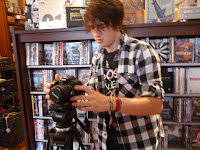
These images show us operating the external boom mic for the first time whilst filming. This was during our time in our second location within a small record shop.


Another new experience for the group was filming within location such as shops where we would need the owner/mangers permission to film anything on the premises, and we needed a release form signed, dated an with the address of the location clearly visible as evidence that we were given permission to film in that location. This was something we had never done before so it was nerve racking at first, but in all the locations we politely explained the situation and what our task was and they seems very cooperative and friendly and gave us permission, we did this in three different locations and each time the employees were very accepting in allowing us to film on the premises. During the time we were using the external boom mic we were in our second location and one of the employees was kind enough to allow us to interview him, which would prove useful, so the process of using release forms and obtaining permission to film in locations seemed to be fairly easy and would help improve our people skills and communicating, which proved very useful during our time in Oxford.
These are some shots of our group performing various shots during the time we were moving to and from our set locations, as during the commute between areas we were often distracted by certain places of interest that we thought would provide some useful footage and also we needed to perform specific shots that we needed and some of the locations we found seemed to be appropriate.




Among all the problems we encountered the trip was in essence a very productive day for us as we obtained a vast amount of different shots and locations which will provide decent footage for use in editing later. Not only was the trip productive but it was also entertaining and provided us with many new experiences and most likely helped to improve our work in the future as we gained some knowledge of using an external mic and developed our communication skills to some level.
One of the things that had the most likely possibility of going wrong was using the external boom mic as it was a piece of equipment none of us had previous experience with, save for a quick tutorial the day prior to the trip, although the person chosen to operate it performed rather well, since we used it during a Vox pop interview with a shop employee the use of the external mic was needed, however when reviewing the footage we found there was a large amount of background noise that distorted the sound, so the first use of the external mic did not go to plan however the footage is still usable.
These images show us operating the external boom mic for the first time whilst filming. This was during our time in our second location within a small record shop.


These are some shots of our group performing various shots during the time we were moving to and from our set locations, as during the commute between areas we were often distracted by certain places of interest that we thought would provide some useful footage and also we needed to perform specific shots that we needed and some of the locations we found seemed to be appropriate.


Among all the problems we encountered the trip was in essence a very productive day for us as we obtained a vast amount of different shots and locations which will provide decent footage for use in editing later. Not only was the trip productive but it was also entertaining and provided us with many new experiences and most likely helped to improve our work in the future as we gained some knowledge of using an external mic and developed our communication skills to some level.
Wednesday, 7 November 2012
Oxford: Trip Summary
On the 23rd October 2012 our group visited the city of Oxford in order to shoot more film footage for our new wave project that would contrast to what we had previously shot, we decided that we would require certain types of shots and know exactly what locations we were going to visit before the trip so the previous day was spent planning everything we would need in other to fulfil our task, such as what equipment and shots we would need and what roles everyone would fill. The trip involved a great deal of planning as there were many things to consider beforehand including working out a schedule that we would follow to keep us all on task during the trip, also including equipment lists, shot types and also the handling of release forms for in case we needed to film inside a building and needed the owners permission.
The overall time we would spend in Oxford would amount to approximately five hours in total excluding time spent travelling to and from Oxford so we had a reasonable amount of time to get all of the shots we required so a schedule had to be put in place to ensure we moved on to new locations periodically to get all the footage we needed. Another requirement was a set shot list so that we knew exactly hat we needed to shoot to ensure that we didn't capture anything unnecessary that would waste time, energy and memory card space on the cameras, this would help in the fact that when we shoot in a location we immediately know what to shoot and this will help save time during the process. One other requirement we needed to complete was the use of the cameras internal mic and an external boom mic so during the visit we needed to perform a Vox Pop interview with a few of the local residents, however the external boom mic was another piece of new equipment for us so a tutorial was needed the day before to ensure that at least one member knew how to operate it when we arrived.
OH&S: Occupational Health and Safety
Of course whilst in Oxford there are the Health and Safety issues that need to be analysed and resolved before commencing filming in order to keep all crew members safe at all times throughout the visit, As it is a new area that none of us were familiar with there is the possibility of many high risks that needed to be taken into account. These risks include the following:-
The overall time we would spend in Oxford would amount to approximately five hours in total excluding time spent travelling to and from Oxford so we had a reasonable amount of time to get all of the shots we required so a schedule had to be put in place to ensure we moved on to new locations periodically to get all the footage we needed. Another requirement was a set shot list so that we knew exactly hat we needed to shoot to ensure that we didn't capture anything unnecessary that would waste time, energy and memory card space on the cameras, this would help in the fact that when we shoot in a location we immediately know what to shoot and this will help save time during the process. One other requirement we needed to complete was the use of the cameras internal mic and an external boom mic so during the visit we needed to perform a Vox Pop interview with a few of the local residents, however the external boom mic was another piece of new equipment for us so a tutorial was needed the day before to ensure that at least one member knew how to operate it when we arrived.
OH&S: Occupational Health and Safety
Of course whilst in Oxford there are the Health and Safety issues that need to be analysed and resolved before commencing filming in order to keep all crew members safe at all times throughout the visit, As it is a new area that none of us were familiar with there is the possibility of many high risks that needed to be taken into account. These risks include the following:-
- Risk of getting lost as it is a new area
- Risk of being hit by a car/other motor vehicle
- Risk of damaging equipment
- Risk of theft of equipment by means of either leaving unattended/robbery
- Risk of being mugged
- Risk of injury by means of falling/misuse of equipment/accident/other
- Risk of injury to other people due to misuse of equipment/accidental circumstances
- Avoid speaking to strangers
- Always move in a group
- Always have at least one person attending the equipment at all times
- Use caution when crossing roads and busy streets
- Ensure equipment is handled appropriately and safely to avoid risk of injury to oneself or others
- Ensure that a method of navigating is being used e.g. local map, compass, GPS etc.
Monday, 15 October 2012
3rd Outing: Tracking Shots
On the 3rd time we went out filming we realised we needed tracking shots that could capture some of the conventions of new wave, so we decided to choose a location that could capture the essence of a social issue affecting the local area such as unemployment. We decided to capture some static tracking shots initially just to determine if the way we were shooting the footage and the location would work out the way we hoped. The footage is new wave in the fact it is filmed in a location that reflects a social issue and we were using only one camera, as we have no budget similar to French New Wave films that are filmed with little or no budget at all.
static tracking shots from Lewis Mercer on Vimeo.
The footage is comprised of shots from two different viewpoints and angles, and I edited it together to give it the appearance of a quick cut, a technique often used in New Wave films, the footage is also shot in high contrast monochrome, another convention of French New Wave, also because the footage was shot in a local area with real peoples reactions to the camera being captured. the footage shows a subject walking through an area that has many rundown shops that have gone out of business to highlight the possible social issue of unemployment in the area.
OH&S: Occupational Health and Safety
During this outing we would be out in public filming shots for our New Wave project and there would be a various amount of safety concerns that we would need to address before we commenced filming as we would be carrying expensive filming equipment and would be in a high traffic area with a large amount of people in the vicinity so we would need to be aware of the various hazard that could occur during the shoot.
static tracking shots from Lewis Mercer on Vimeo.
The footage is comprised of shots from two different viewpoints and angles, and I edited it together to give it the appearance of a quick cut, a technique often used in New Wave films, the footage is also shot in high contrast monochrome, another convention of French New Wave, also because the footage was shot in a local area with real peoples reactions to the camera being captured. the footage shows a subject walking through an area that has many rundown shops that have gone out of business to highlight the possible social issue of unemployment in the area.
OH&S: Occupational Health and Safety
During this outing we would be out in public filming shots for our New Wave project and there would be a various amount of safety concerns that we would need to address before we commenced filming as we would be carrying expensive filming equipment and would be in a high traffic area with a large amount of people in the vicinity so we would need to be aware of the various hazard that could occur during the shoot.
- High volume of traffic that could prove dangerous
- Be aware of the locations reputation e.g. is it known to have high crime rates
- Risk of injury due to falling/dropping equipment/being knocked by passers by/ being hit by traffic/misconduct
- Risk of being hit by traffic as it was a busy area built up area
- Risk of being mugged/robbed
- Risk of dropping/damaging equipment
- Risk of injuring other people through dropping equipment/misconduct
- Always travelling in groups to avoid being mugged/robbed in public
- Share the equipment equally so no one person is over encumbered and risks dropping the equipment and damaging it
- Take caution whilst travelling directly next to the road to avoid falling and being hit by oncoming traffic
- Ensure that the camera and equipment is never left unattended
- Ensure that whilst filming no passers by accidentally knock over or damage any equipment
- Ensure that whilst filming you are in a relatively open area and easily visible to avoid getting in the way of other people trying to get past
- If and wherever possible film from a location that is out of the way and will cause the least disruption to other people around you
- Ensure that all equipment is secured in a safe manner before commencing filming and packed away whilst travelling to a new posit or location
Wednesday, 10 October 2012
2nd Outing: Camera Movements
During the time that we were filming on location for the second time, we decided to take some shots from an escalator to try and get some interesting camera movements, we had a subject go up and down on as set of escalators and had the camera placed either in front of or behind them, to capture the movement of the subject whilst remaining in focus, and to create a simple, interesting tracking shot.
escalator footage from Lewis Mercer on Vimeo.
This technique is considered a New Wave camera movement because it is using innovative use of the environment to create a tracking shot of the subject in an interesting way, and also because this technique requires no other special equipment and simply uses modes of transport already present in the environment to its advantage.
This footage is similar to a scene in Jean-Luc Godard's film "Breathless" where the camera is placed on an escalator facing a woman who is travelling up them which then turns to a tracking shot, so we were trying to recreate that in our footage by using a new wave technique.

escalator footage from Lewis Mercer on Vimeo.
This technique is considered a New Wave camera movement because it is using innovative use of the environment to create a tracking shot of the subject in an interesting way, and also because this technique requires no other special equipment and simply uses modes of transport already present in the environment to its advantage.
This footage is similar to a scene in Jean-Luc Godard's film "Breathless" where the camera is placed on an escalator facing a woman who is travelling up them which then turns to a tracking shot, so we were trying to recreate that in our footage by using a new wave technique.

OH&S: Occupational Health and Safety
During the filming of this scene and while practicing this technique there were a few health and safety concerns that needed to be addressed as both the subject and the person operating the camera would be on a moving platform, and there would be other people around them as they were in a public area. These hazards include:
- Both the subject and camera operator would be on a moving surface and could slip/fall and/or injure others nearby
- They would be holding expensive equipment and would be at risk of damaging it
- Risk of falling on the escalator
- Risk of injuring themselves and/or others
- Behaving appropriately whilst on the escalators
- Ensure that the subject and camera operator are standing firmly on the escalator
- Ensure that either the subject or camera operator has one hand on the railing for support to avoid loss of balance whilst either ascending or descending
- Ensure that no other people are in very close proximity to the subject/ camera operator whilst filming.
- Consider that other people will be around during filming and that crew members should stay a safe distance from them whilst on the escalators.
Subscribe to:
Posts (Atom)